Myto’s Arrow
The Last JediMyto’s Arrow is a narrow hyperspace corridor from the galaxy’s fringes to Dantooine, threading unstable space shaped by the gravitational tides of the binary stars known as the Twins. Its danger is also its tactical advantage: the pair’s sharply fluctuating magnetic fields can cloak a ship’s changes in attitude. A pursued pilot could enter the binary’s gravitational coil, drop out of hyperspace long enough to alter course radically, then jump again in a different direction while the pursuer tried to determine where the ship had gone. The route thus offers not simple concealment, but a chance to make pursuit uncertain at precisely the moment a pursuing vessel needs a reliable track.
Geography and Navigational Use
The corridor’s usefulness depends on the interaction of its hazards. The Twins make the surrounding space unstable, while their changing magnetic fields obscure a ship’s maneuvering. The tactic described for the route is conditional rather than effortless: it requires a master pilot to enter the gravitational coil, make a brief course change, and resume hyperspace travel before an enemy can work out the new direction. Myto’s Arrow is therefore a possible escape path whose protection comes from skill and timing as well as from local conditions.
That possibility matters in a story where a route can serve as more than a line between two destinations. A ship entering the corridor might use its unusual conditions to break an enemy’s pursuit, but the route itself could also expose the ship’s intended destination. Dantooine lies at its far end, giving the name a navigational meaning that can be recognized even when it is invoked obliquely.
The Route Debate
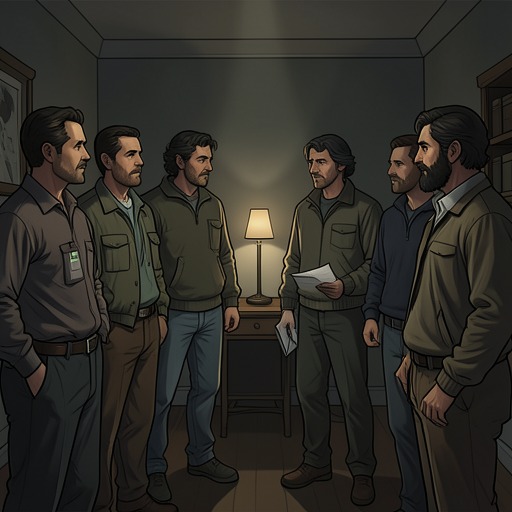
Myto’s Arrow arose as one option in a heated consultation about how the Far Ranger should travel to Dantooine. Laranth Tarak and I-Five argued for a direct course through Wild Space and onward into the corridor. Tuden Sal and Thi Xon Yimmon preferred the more ordinary approach of following a heavily traveled trade lane. The disagreement was practical: the direct route offered a distinctive, hazardous passage, while the trade-lane approach could make a ship carrying subversives appear to be conducting routine cargo business.
Sal recommended putting in at Bandomeer, despite its pronounced Imperial presence after Darth Vader had crushed the miners’ revolt there the previous year. Laranth Tarak objected that the Emperor kept a watchful eye on the planet. Sal’s counterargument was that Imperial attention might itself help disguise them: a freighter on an ordinary commercial call would be less remarkable than a ship taking an unusual route. Thi Xon Yimmon ultimately agreed with Sal. He reasoned that a succession of regular ports, with cargo taken on and off, could cause anyone who suspected the Far Ranger to lose interest.
The resulting itinerary was along the Hydian Way, toward the Corporate Sector, but not as far as that destination implied. The Far Ranger was to stop at Bandomeer, communicate briefly with a nascent resistance cell, and continue through Botajef, Celanon, and Feriae Junction before reaching Toprawa to contact the remnant of the Antarian Rangers. This was the chosen plan, not evidence that the ship actually traversed Myto’s Arrow. The distinction gives the route a double place in the narrative: it is first considered and rejected as the group’s immediate approach, yet remains important as a recognizable path toward Dantooine.
A Pilot’s Indirect Reference
Later, Jax Pavan used the route’s geography as an indirect reference. In a conversation with Aren Folee, he drew a long diagonal line on a tabletop and marked its endpoint with a sharp tap. Folee understood the pilot’s reference: the planet at the point of Myto’s Arrow was Dantooine. The gesture turns the corridor into a compact piece of shared navigational knowledge. Rather than naming the destination outright, Jax gives a pilot a line and a point, trusting her to supply the geography.
Folee’s recognition also connects the route to the possibility of cooperation. After understanding the reference, she asked whether the move meant that their efforts were close to being joined against their competitors. The exchange does not establish that Myto’s Arrow was being used as a literal route at that moment; it shows that its endpoint could communicate an intended destination within a negotiation. The corridor consequently functions both as a feature of space and as a shorthand whose meaning depends on a listener’s familiarity with piloting.
Intelligence and the Cost of a Route
Myto’s Arrow later appears in an encrypted message from Tuden Sal to Darth Vader. Pol Haus discovers the text in Sal’s private correspondence after Sheel Mafeen retrieves a prioritized download of material mentioning Jax Pavan, Laranth Tarak, Vader, or the Emperor. The message reports reason to suspect that Pavan and other persons of interest were moving through Myto’s Arrow, and its date range overlaps with the period when Jax and his companions were moving Thi Xon Yimmon.
The message makes the corridor consequential in a way its physical hazards alone do not explain: knowledge of a possible passage can become intelligence for the Empire. Yet Sal’s disclosure is limited. He sent the message anonymously, encrypted it, and routed it through a shadow link and multiple nodes; it gave only minimal location and timing data, although he knew the Far Ranger’s itinerary. Haus points out that Sal could have directed Imperial forces to Toprawa on the exact day of Thi Xon Yimmon’s arrival there, but the message did not do so. The evidence therefore exposes Sal’s betrayal without resolving why he withheld the most precise information. Myto’s Arrow remains a suspected part of the group’s movements, not proof of their exact course, and that uncertainty is central to the message’s force: even an incomplete report can put a route, a destination, and the people aboard a ship at risk.